
Hybrid Work Is No Longer Just a Perk: Why Employers Need a Safer, Smarter Work From Home System

Working from home has changed.
For a while, it was treated as a temporary pandemic response. Then it became a workplace preference. Now, especially in Victoria, it is becoming part of a much bigger conversation around flexibility, productivity, health, safety, wellbeing and employer responsibility.
With proposed Victorian work from home laws due to commence from 1 September 2026, hybrid work is no longer something organisations can manage casually or inconsistently.
For employers, HR teams, WHS leaders and People & Culture professionals, the question is no longer:
“Should we allow people to work from home?”
The better question is:
“How do we make hybrid work safe, sustainable, productive and compliant?”
That is where the real opportunity sits.
The work from home conversation has matured
Working from home was once mainly viewed through the lens of convenience.
Less commuting. More flexibility. Better balance. More time with family. Fewer distractions for deep work.
All of these benefits matter. For many employees, working from home can genuinely improve quality of life, reduce stress and increase their ability to participate fully in work.
But employers are now having to look at hybrid work through a wider lens.
It is not just about where someone opens their laptop. It is about whether the organisation has a clear, practical and repeatable system for managing the health, safety and wellbeing risks that come with distributed work.

That includes:
workstation setup
physical discomfort and injury prevention
prolonged sitting
screen fatigue
communication patterns
isolation
psychosocial risk
boundaries between work and home
manager capability
record keeping
follow-up actions
consistency across teams
Hybrid work can absolutely work well. But it works best when it is designed, not guessed.
Flexibility without structure can create hidden risk
One of the biggest challenges with working from home is that risk becomes less visible.
In an office, it is easier to see if someone is sitting poorly, using a chair that does not support them, working from a cramped space or struggling with their workstation.
At home, those issues can go unnoticed for months.
Someone may be working from a dining chair, kitchen bench, couch, bed, spare room, garage or shared family space. They may be using a small laptop screen for long periods, reaching awkwardly for a mouse, sitting too low, sitting too long or working in a way that slowly builds discomfort.
Most people do not intentionally set themselves up poorly.
They simply do the best they can with what they have.
The issue is that small daily problems can become bigger health and safety concerns over time. A stiff neck becomes a regular headache. A sore lower back becomes a recurring injury. Shoulder tension becomes sleep disruption. Fatigue becomes disengagement.
This is why working from home should not be treated as “set and forget”.
Psychosocial risk is part of the hybrid work conversation

The other major piece is psychological health and wellbeing.
Hybrid work can improve wellbeing for many people. It can reduce commute stress, increase autonomy and provide more flexibility around life responsibilities.
But it can also create new risks when it is not managed well.
Remote workers may experience:
reduced informal connection
less spontaneous support
unclear expectations
blurred boundaries
digital overload
too many online meetings
difficulty switching off
reduced visibility
less access to learning by observation
isolation from team culture
None of this means working from home is bad.
It means working from home needs to be supported properly.
A well-designed hybrid work system should help employees feel connected, clear, supported and safe — not just physically comfortable.
This is especially important for leaders and managers. In a hybrid environment, managers need to be more intentional about communication, expectations, check-ins and early intervention. The casual “How are you going?” conversation at the office does not always happen naturally when people are working remotely.
It has to be built into the system.
The compliance piece is only part of the story
With legislation and workplace regulation moving in this direction, some organisations will naturally focus on compliance first.
That is understandable.
Policies, procedures, risk assessments, employee agreements and documented processes all matter.
But the organisations that do this best will go further than compliance.
They will ask:
Are our people actually set up safely at home?
Do our managers know how to support hybrid teams?
Are we identifying physical and psychosocial risks early?
Do employees know how to work well from home?
Are we keeping useful records?
Are we reviewing our system regularly?
Are we making it easy for people to report concerns?
Are we supporting performance, not just flexibility?
Compliance is the floor. Culture is the ceiling.
A tick-box approach may help you say, “We have a policy.”
A well-designed system helps you say, “We know our people are supported, our risks are being managed and our hybrid work model is actually working.”
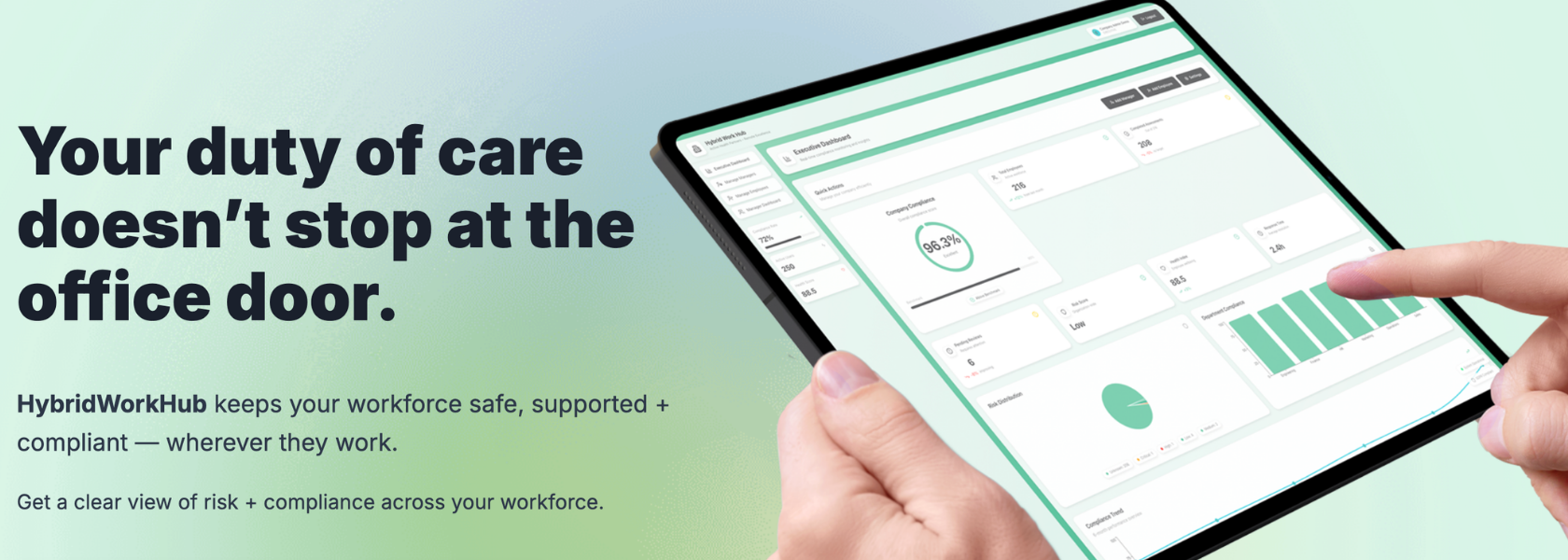
Find out more here
Hybrid work should support performance, not reduce it
A common concern from employers is productivity.
Will people work as effectively from home? Will collaboration suffer? Will culture weaken? Will younger or newer employees miss out on learning? Will managers lose visibility?
These are fair questions.
But the answer is not necessarily to bring everyone back to the office full time.
The better answer is to design hybrid work properly.
High-performing hybrid teams tend to have:
clear expectations
planned office days
purposeful collaboration time
good home workstation setups
healthy communication norms
strong manager check-ins
clear boundaries around availability
practical training
regular review of what is and is not working
Hybrid work is not just an employee benefit. Done well, it can become a performance strategy.
People can use home days for focused work, reduced interruption and flexibility. They can use office days for collaboration, relationship building, mentoring, creative work and culture.
The key is being deliberate.
Random hybrid work often becomes messy. Designed hybrid work becomes powerful.
A practical system for safer hybrid work
For organisations preparing for the future of work, now is the time to get the foundations right.
A practical hybrid work system should include five key components.
1. Clear policy and expectations
Employees need to understand who can work from home, how requests are managed, what expectations apply, how communication works, and what support is available.
This should be written in plain English and supported by managers, not buried in a document nobody reads.
2. Work from home health and safety checklist
Every employee working from home should complete a structured self-assessment of their home workstation and work environment.
This should cover equipment, seating, desk setup, screens, lighting, trip hazards, emergency considerations, discomfort, work habits and psychosocial factors.
A good checklist does more than collect information. It helps employees think differently about their own setup.
3. Practical training
Most people have never been taught how to set up a workstation properly.
They may not know how high their screen should be, where their feet should sit, how to use a laptop safely, how often to move, or how posture, breathing and fatigue are connected.
Short, practical training can make a big difference.
The aim is not to make employees ergonomic experts. It is to give them enough knowledge to make better daily choices and raise concerns earlier.
4. Early intervention pathway
If an employee reports discomfort, poor equipment, isolation, stress, poor setup or uncertainty, there needs to be a clear next step.
That may include an equipment recommendation, manager conversation, ergonomic assessment, wellbeing check-in or referral to further support.
The worst outcome is collecting information and then doing nothing with it.
5. Records and review
Hybrid work systems should create useful records.
Not excessive paperwork. Useful records.
Employers should be able to show that they have provided guidance, asked the right questions, reviewed risks, responded to concerns and supported workers appropriately.
This is where digital systems can save time and improve consistency.
Why this matters now

The organisations that act early will be in a much stronger position.
They will not be scrambling to respond when legislation changes, when employees ask more questions, or when issues arise.
They will already have a system.
They will know who is working from home, what support they need, what risks have been identified and what actions have been taken.
They will also send an important message to their people:
“We trust you to work flexibly, and we care enough to make sure you can do it safely and sustainably.”
That is a powerful message.
Hybrid work is here to stay — but it needs to be healthier
The future of work is not simply office versus home.
It is not flexibility versus productivity.
It is not employee preference versus employer responsibility.
The future is about building a model that supports people and performance at the same time.
Hybrid work can be a genuine advantage for Australian workplaces. It can help people work with more flexibility, reduce unnecessary commuting, support inclusion, improve focus and create better work-life integration.
But only if it is managed with care.
The next stage of hybrid work needs to be more mature, more practical and more human.
That means moving beyond policy and into implementation.
It means giving employees the tools, training and support to work well from home.
It means helping managers lead hybrid teams with clarity and confidence.
It means identifying physical and psychosocial risks early.
And it means recognising that workplace health and safety does not stop at the office door.
How Active Health Partners can help
At Active Health Partners, we help organisations make hybrid work safer, healthier and easier to manage.
Our Hybrid Work Hub, working-from-home checklist and training, workstation ergonomic assessments and workplace training programs are designed to help employers support their teams practically — without making the process overwhelming.
The goal is simple:
Help your people work well, wherever work happens.
If your organisation is reviewing its hybrid work, work from home or employee wellbeing processes, this is a good time to get ahead of the conversation and build a system that supports both your people and your business.
