
Working From Home Safety: What Employers Need to Know About Victoria’s Changing WFH Laws

Victoria’s proposed work-from-home laws are changing, but one thing has not changed: employers still need to manage the health and safety risks associated with employees working from home. Here is what Australian employers should be thinking about now.
There has been another significant development in Victoria’s proposed work-from-home laws.
Victoria’s new Premier, Ben Carroll, has indicated that the Government intends to proceed with its proposed right for eligible employees to work from home for at least two days each week where reasonable.
However, one important part of the original proposal appears set to change.
Employers would no longer automatically be required to pay for an employee’s home-office setup.
For many employers, that will be welcome news.
But it also creates an important distinction that could easily get lost in the headlines:
Not having to automatically buy an employee’s home-office equipment is not the same as having no responsibility for their health and safety when they work from home.
And this is where organisations need to be careful.
The WFH conversation has become too focused on equipment
For years, workplace ergonomics was often reduced to a fairly simple conversation:
Do they have a good chair?
Is the monitor at the right height?
Do they need a separate keyboard and mouse?
Those things certainly matter.
I have assessed hundreds of people working from home, and poor workstation setup can absolutely contribute to neck, shoulder, back, wrist and other musculoskeletal problems.
But a safe and sustainable home-working arrangement involves much more than equipment.
Safe Work Australia identifies a much broader range of potential WFH hazards, including poor workstation setup, inadequate lighting and temperature, sedentary work, fatigue, long working hours, poor support, unclear roles and other psychosocial hazards.
So when we assess whether somebody can work safely and effectively from home, the question should not simply be:
“Who is paying for the chair?”
The better question is:
“What risks are present, and how are we managing them?”
The workplace does not stop at the office door
One of the biggest changes in workplace health and safety over the past few years is that the physical workplace is no longer necessarily a single location.
An employee might work Monday and Tuesday at home, Wednesday in a corporate office, Thursday from another company location and Friday back at home.
From an employee’s perspective, that is simply their working week.
From an employer’s health and safety perspective, however, it creates a much more distributed workplace.
Safe Work Australia makes clear that the obligation to manage workplace health and safety risks extends to employees working from home. Employers must manage risks so far as reasonably practicable and consult workers about health and safety matters that directly affect them.
WorkSafe Victoria similarly states that employers have duties regarding employees working from home and should consult employees and health and safety representatives about risks, hazards and controls.
This does not mean an employer needs to physically inspect every employee’s spare bedroom.
It does mean employers need a reasonable way of understanding and managing the risks.
And importantly, they need a process that works at scale.
A $1,500 ergonomic chair is not always the answer
One mistake I regularly see is jumping straight from “there is a problem” to “let’s buy some equipment”.
Sometimes that is absolutely appropriate.
Sometimes it is not.
An employee experiencing neck discomfort may already have a perfectly suitable chair.
The actual problem might be that their laptop is sitting directly on the dining table, forcing them to look down for seven hours.
Another employee may have a good sit-stand desk but barely move all day.
Another may have excellent ergonomic equipment but be regularly working through lunch, answering emails at 9 pm and feeling disconnected from their manager and colleagues.
These are three very different risks requiring three very different responses.
That is why assessment needs to come before intervention.
Good ergonomics is not about buying the most expensive chair.
It is about matching the working environment, equipment and work practices to the person doing the work.

Physical and psychosocial health cannot be separated
This is becoming increasingly important for hybrid employers.
A person sitting at home with back pain may also be experiencing high workload, poor support or difficulty switching off.
Those issues can interact.
WorkSafe Victoria describes psychosocial hazards as factors in the design or management of work that can increase work-related stress and potentially lead to psychological or physical harm. Victoria’s psychological-health regulations have strengthened the requirement for employers to identify and control these risks.
Safe Work Australia also specifically identifies poor support, low role clarity, high or low job demands and fatigue among potential WFH hazards.
This means a contemporary WFH assessment should not only ask:
“Is your screen at eye level?”
It should also consider questions such as:
Do you feel adequately supported when working remotely?
Are expectations around availability clear?
Are you regularly working outside normal hours?
Do you take appropriate breaks?
Do you feel connected with your manager and team?
Is there anything about your working arrangement making it difficult to perform your role safely or effectively?
None of these questions needs to turn an ergonomic assessment into a psychological examination.
They are simply sensible workplace risk questions.
The real challenge for employers is scale
Managing one employee working from home is not particularly difficult.
Managing 300 is different.
Imagine an organisation with 500 employees, 350 of whom work remotely two or three days each week.
How does HR or WHS know whether those employees:
have received appropriate WFH health and safety training
have assessed their workstation
understand how to set up their equipment
know how to report discomfort or hazards
are experiencing emerging physical or psychosocial risks
require further intervention
have received appropriate follow-up
If the answer involves several spreadsheets, forms, email chains and individual managers remembering to follow things up, the system becomes difficult to manage very quickly.
This is where I believe the next evolution of hybrid workplace health and safety needs to occur.
We need to move from individual WFH arrangements to organisational WFH systems.
What should employers be doing now?
Whether Victoria’s proposed legislation ultimately commences exactly as currently planned or undergoes further amendment, employers do not need to wait to improve their processes.
Start with five practical questions.
1. Do we know where our people are working?
You cannot manage a risk you do not know exists.
2. Have employees received practical WFH safety training?
A policy sitting on an intranet is not the same as teaching somebody how to work safely.
3. Has the home workstation actually been assessed?
For many employees, a structured self-assessment will be sufficient. Higher-risk situations can then be escalated for professional ergonomic assessment.
4. Are we considering psychosocial as well as physical risks?
Workload, support, isolation, communication, role clarity, working hours and boundaries all matter.
5. Can we demonstrate what we have done?
Training, assessment, identified risks, recommendations and follow-up should create a useful record.
That final point will become increasingly important as hybrid work becomes a permanent part of Australian employment.
Good WFH systems should not create more administration
There is understandable concern among employers that another layer of WFH regulation will create more work for HR, WHS and managers.
It does not have to.
A well-designed system should do the opposite.
Employees should be able to complete appropriate training and assessment independently.
Low-risk employees should receive useful information and recommendations without requiring manual intervention.
Higher-risk issues should be identified and escalated.
Managers should be able to see what requires action.
And organisations should have a useful record showing what has occurred.
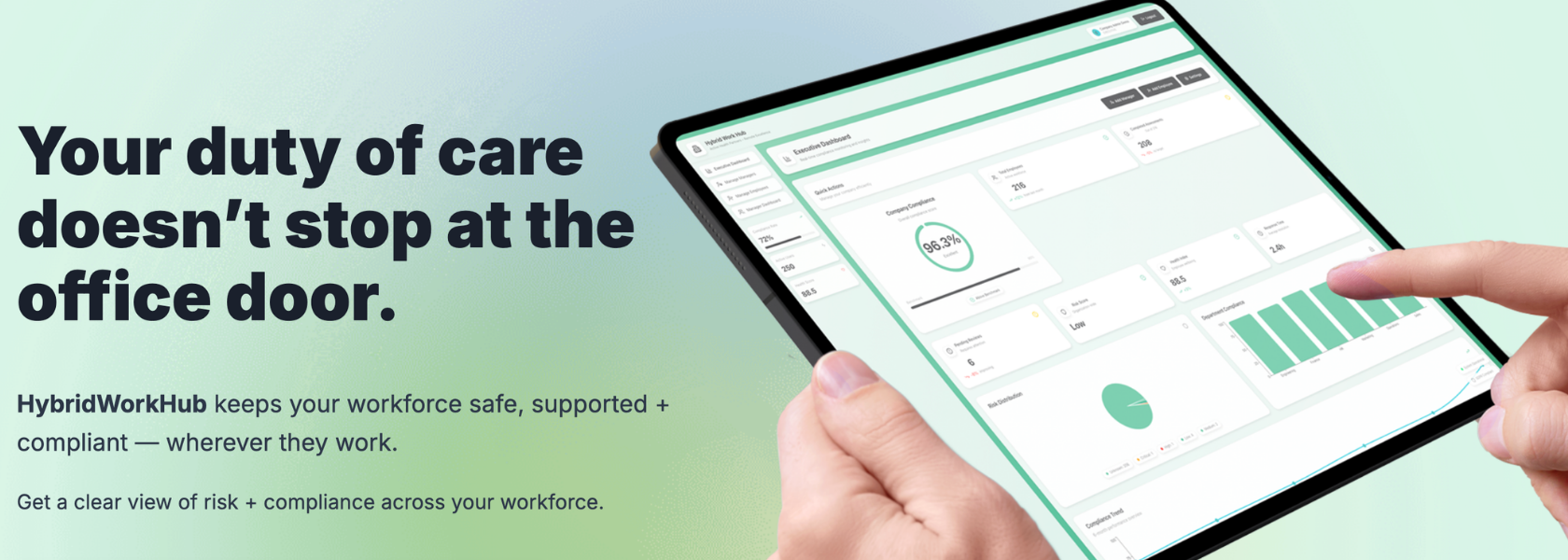
That philosophy is behind the work we are doing at Active Health Partners with our Hybrid Work Hub.
The objective is not to create another compliance exercise.
It is to make it easier for organisations to identify problems early, provide the right level of support and demonstrate a sensible approach to managing their hybrid workforce.
Find out more here
The bigger picture
The Victorian WFH debate will continue.
There will be arguments about productivity, CBD activity, employee flexibility, business costs and exactly where the line between employer and employee responsibility should sit.
Those are important discussions.
But from a workplace health and safety perspective, the principle is much simpler.
If work is happening at home, we need a sensible way of making sure that work can be performed safely.
That does not mean every employee needs a $1,500 chair.
It does not mean employers need to send an ergonomist into every home.
And it does not mean creating another mountain of paperwork.
It means having a proportionate, practical and repeatable process for training people, identifying risks and responding when support is needed.
As hybrid work becomes increasingly embedded in Australian workplaces, that is where I believe employers should be focusing their attention.

Daniel Grynberg is Director of Active Health Partners and works with Australian organisations to improve hybrid workplace health, safety, ergonomics and employee wellbeing. Active Health Partners provides workplace training, ergonomic assessments and hybrid workplace health and safety solutions for organisations across Australia.
